
Close Menu
    Facebook X (Twitter) Instagram
    • Contact Us
    • эскорт москва сити
    • Who We Are
    check the science
    • Education
    • Teaching
    • Homeschooling
    • Educational Funding
    • Online Education
    check the science
    Home»Education»Elastic Collisions & Energy Conservation: Interactive Newton’s Cradle Simulator
    Education

    Elastic Collisions & Energy Conservation: Interactive Newton’s Cradle Simulator

    Santos B. MajorBy Santos B. MajorNovember 18, 2026No Comments4 Mins Read
    Facebook Twitter Pinterest LinkedIn Tumblr Email
    Share
    Facebook Twitter LinkedIn Pinterest Email

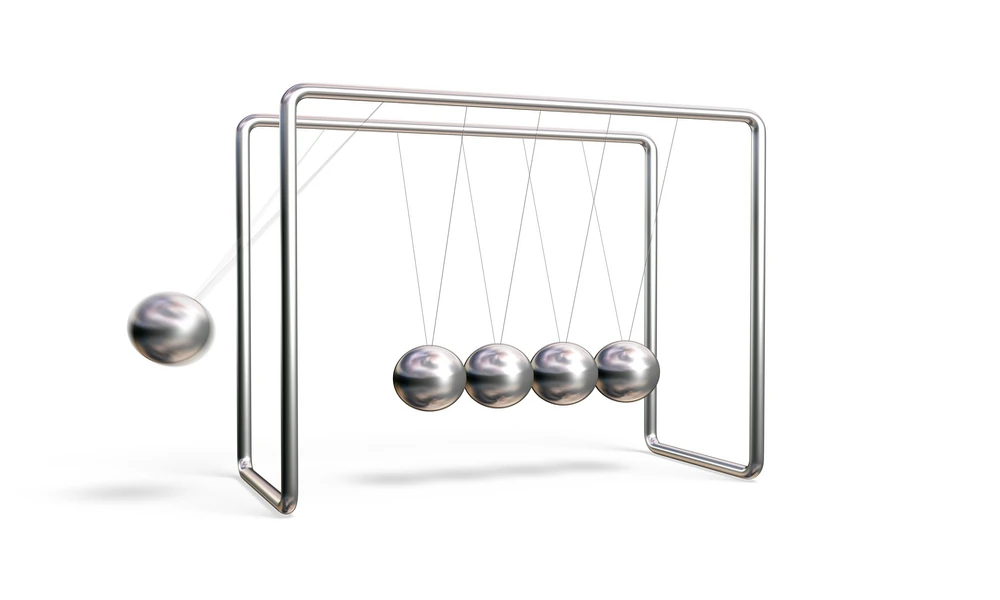
    The Newton’s Cradle experimental simulator is an essential revision and classroom tool for high school physics students studying classical mechanics. By exploring multi-ball binary setups, learners develop a strong physical intuition for how elastic collisions preserve both momentum and kinetic energy. The interface created by Active Kinetic 1 allows users to isolate momentum telemetry, track kinetic energy changes, or view both metrics simultaneously alongside pause and slow-study controls for detailed frame-by-frame analysis.

    The Newton’s cradle simulator is an accessible STEM education resource because it blends scientific observation with experimentation, measurement and mathematical thinking. Its design is simple enough to capture the interest of younger students, yet the interactions between its suspended metal balls can support substantial study in secondary schools, colleges and university physics courses. This range makes it useful for teachers who want one demonstration to serve several learning objectives.

    In science lessons, the cradle introduces force, motion, momentum and energy conservation. In mathematics, students can calculate mass-dependent momentum, estimate energy from release height or graph the decrease in swing amplitude over time. Engineering classes can discuss why precise alignment, frame rigidity and material selection matter. Technology activities can use smartphone slow-motion recording or motion-tracking software to turn an ordinary demonstration into a small data-analysis project.

    The most effective exercises encourage learners to make predictions before experimenting. For example, a class might compare the motion produced by releasing one ball with the motion produced by releasing two. Another group might change the release height, measure the maximum height reached on the opposite side and discuss energy losses. Students can record observations, repeat trials and account for measurement uncertainty rather than assuming that every collision is perfectly elastic.

    The Newton’s cradle is also suitable for science clubs, museum displays and home learning, where the visible movement provides an immediate starting point for questions. Its familiar appearance helps attract attention, while the underlying physics gives learners something substantial to investigate. For assessment, students might present a short explanation supported by diagrams, observations and calculated values, demonstrating both communication skills and scientific understanding. Used with thoughtful questions and simple measurements, it supports curiosity, collaboration, experimental design and a deeper appreciation of how STEM subjects connect in real mechanical systems.

    Beyond idealised textbook scenarios, this interactive simulator demonstrates the practical limits of mechanical systems. Switching from ideal Simple Harmonic Motion to Mechanical Contact Decay reveals how inelastic losses such as acoustic sound waves and thermal dissipation steadily reduce energy retention over repeated impacts. Furthermore, the Paradox mode provides a compelling visual proof of simultaneous conservation laws, illustrating why an unequal split of velocity leads to a sudden loss of total kinetic energy.

    Newton’s Cradle Simulator

    Compare classical mechanical sphere impacts with parallel-face Active Magnetic Cradle (AMC) dipole carriages.


    |

    Regime: Ideal Frictionless SHM
    Impacts: 0  |  Energy Retained: 100.0%

    NS

    ⇄ S–S FLUX

    SN

    ⚡ AMO Oscillation Cadence: Real-Time Lab (~2.46 Hz)
    Period: 406 ms | Handover: 2.5 / 5.0 cyc
    🐢 Slow Study

    ⚡ Fast (2.46 Hz)

    While this simulation visualises the 2.5-cycle kinetic energy handover, the underlying physics of Active Magnetic Oscillation (AMO) remains an active frontier of research. Areas currently beyond the scope of this numerical model include:

    • Higher-Order Multipole Repulsion: Standard dipole approximations do not fully explain the rapid repulsion velocities observed experimentally, which may be driven by higher-order multipole expansion dynamics (such as quadrupole and octupole near-field interactions—currently hypothetical).
    • Electromagnetic-to-Kinetic Conversion: We cannot yet isolate the exact instantaneous conversion function between stored electromagnetic potential energy and resulting kinetic velocity during flux compression.
    • Coupled Potential Equations: Within the non-linear repulsion zone, the governing equations for electromagnetic potential energy and gravitational potential energy cannot be cleanly separated into independent analytical terms.
    • Decay Constant & Period Invariance: The mathematical formulation for the non-linear decay constant and the observed carrier period invariance across varying amplitudes remains open.
    • Wavelet & Modulation Dynamics: Deterministic wavelet cycle structures and non-linear wavelength modulation cadences observed in physical telemetry cannot yet be reproduced via standard time-domain browsers scripts.

    Interactive Telemetry by Active Kinetic 1 Ltd

    Newton’s Cradle •
    Active Magnetic Cradle (AMC) •
    AMO Physics

    Copy and paste this self-contained HTML snippet into any webpage (attribution links must remain intact):

    Share. Facebook Twitter Pinterest LinkedIn Tumblr Email
    Santos B. Major

    Related Posts

    Making Numbers Feel Less Intimidating With the Right Math Tuition Approach

    July 28, 2026

    How to Maintain Section 8 Property Compliance Year-Round

    May 15, 2026

    From Shy To Steady Voices With Speech And Drama In Small Groups

    March 7, 2026
    Leave A Reply Cancel Reply

    Recent Post

    Elastic Collisions & Energy Conservation: Interactive Newton’s Cradle Simulator

    November 18, 2026

    Inherit the Goodness of Data Science in Bangalore via Upskilling

    September 20, 2026

    Making Numbers Feel Less Intimidating With the Right Math Tuition Approach

    July 28, 2026

    How to Maintain Section 8 Property Compliance Year-Round

    May 15, 2026

    From Shy To Steady Voices With Speech And Drama In Small Groups

    March 7, 2026
    • Contact Us
    • эскорт москва сити
    • Who We Are
    © 2026 checkthescience.com. Designed by checkthescience.com.

    Type above and press Enter to search. Press Esc to cancel.